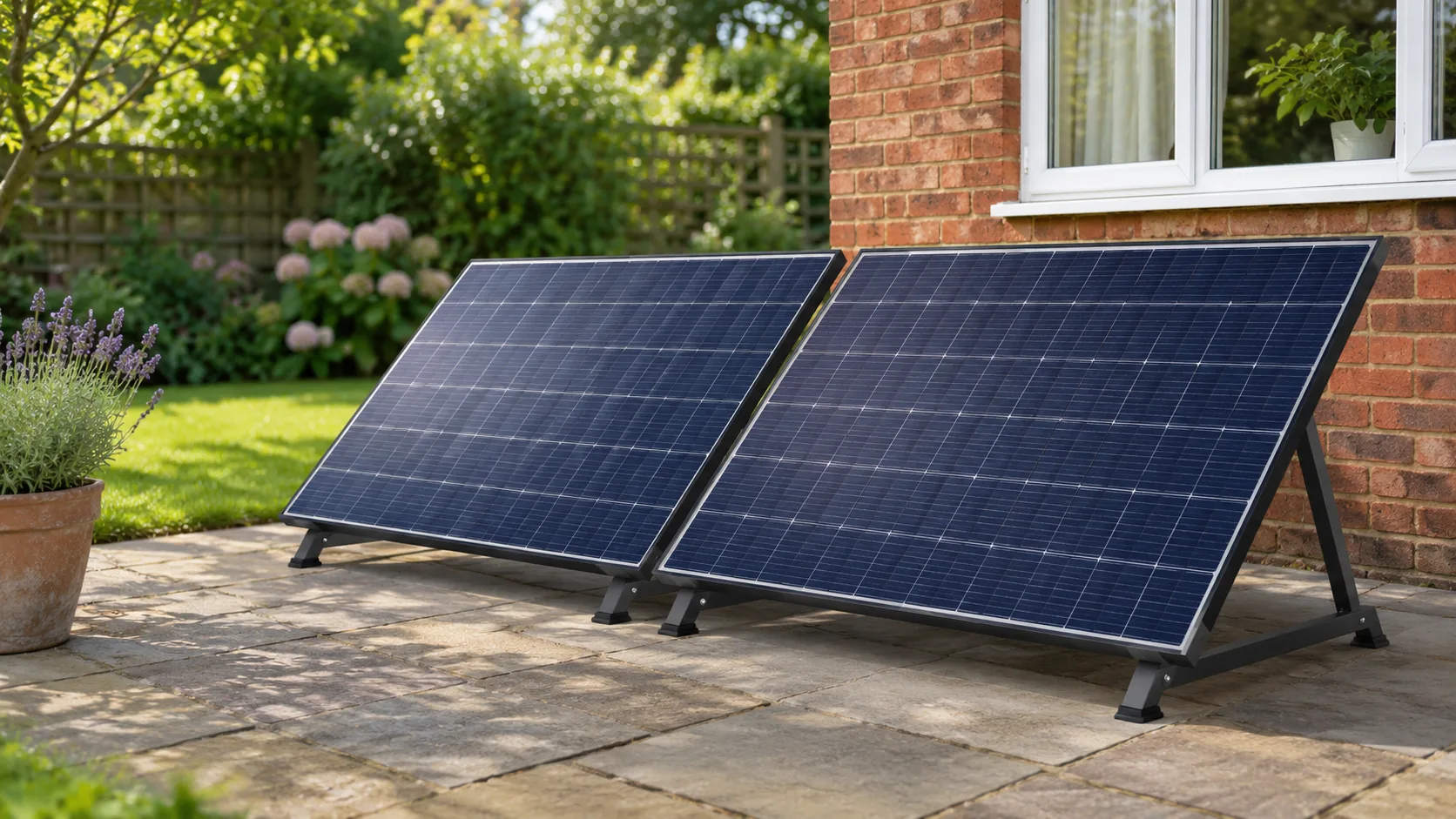
Generating your own electricity is becoming more accessible to households without the budget or roof space for a traditional solar installation.
British Gas has launched a plug-in solar kit starting at £649, joining the growing market for smaller systems that connect through a suitable household socket. Its launch announcement suggests potential savings of £147–£175 a year, depending on how the panels are positioned and how much of their electricity you use. British Gas launch announcement
For anyone considering their first solar purchase, the useful question is how those figures translate to their own home.
Plug-in panels generate electricity from daylight. A microinverter converts it into electricity your appliances can use, reducing the amount you buy from your supplier while the system is generating. The grid supplies any shortfall, and surplus generation flows back to it.
Compliant systems became legal in Great Britain in August 2026. Northern Ireland has separate regulations and, at the time of writing, does not permit their use. Energy Saving Trust’s guide
British Gas offers three packages:
| Package | Price | What’s included |
|---|---|---|
| Solar Start | £649 | Panels, microinverter, cables and mounting equipment |
| Solar Assist | £749 | The kit plus an engineer visit for ground-level setup |
| Solar Ready | £999 | Setup plus an outdoor socket installation |
The supplied mounting brackets are not suitable for balconies. Check the space and mounting requirements before buying, particularly if you live in a flat. British Gas’s packages and specifications
The savings depend heavily on when you use electricity. British Gas’s launch estimate assumes an unshaded, south-facing system tilted at 30 degrees, generating 700 kWh annually. It also assumes the household uses 80–95% of that generation, valued at an electricity price of approximately 26.32p per kWh.
Those are favourable conditions. British Gas acknowledges that UK performance data is still limited and that its estimates are not guaranteed. Savings assumptions
Energy Saving Trust gives a more conservative general estimate of £70–£100 a year. Its modelling uses a different electricity price and distinguishes between households that are home during the day and those that are out. These are different scenarios, so neither figure should be treated as a personalised forecast. Energy Saving Trust’s savings methodology
To see why the assumptions matter, consider these simple examples for a £649 purchase:
| Illustrative annual benefit | Time to recover £649 |
|---|---|
| £70 | About 9.3 years |
| £100 | About 6.5 years |
| £150 | About 4.3 years |
These calculations divide the purchase price by an assumed annual benefit. They exclude additional setup costs, repairs, financing and changes in performance or electricity prices.
A home office, for example, may have daytime electricity demand that overlaps with solar generation. A household using most of its electricity after sunset should examine how much generation it could realistically use.
Export payments can also affect the calculation. British Gas says eligible customers can apply for its Export Premium tariff to receive payment for surplus electricity. Confirm eligibility and the current rate before including export income in your budget. Winter output will also be lower because daylight hours and sunlight levels are reduced. British Gas’s export and generation guidance
Before ordering, check these practical requirements:
- Permissions: Renters and leaseholders should obtain the relevant landlord, freeholder or building manager’s consent.
- Position: Look for a sunny location with secure mounting and enough room for the panels.
- Electrical suitability: The system needs a suitable socket and circuit. Ask a qualified electrician if you are unsure.
- Connection: Plug directly into the appropriate socket; extension leads and adapted plugs are unsuitable.
- Registration: Register the device through the UK Plug-in Solar Registration service.
Energy Saving Trust’s pre-purchase checklist explains these requirements, including checking that the model meets UK standards.
For BitBlaze readers, plug-in solar looks most promising where a modest upfront investment, suitable outdoor space and regular daytime electricity use come together. Start by checking the proposed location and your daytime consumption, then calculate the return using a cautious savings estimate. That will tell you far more than the headline price alone.